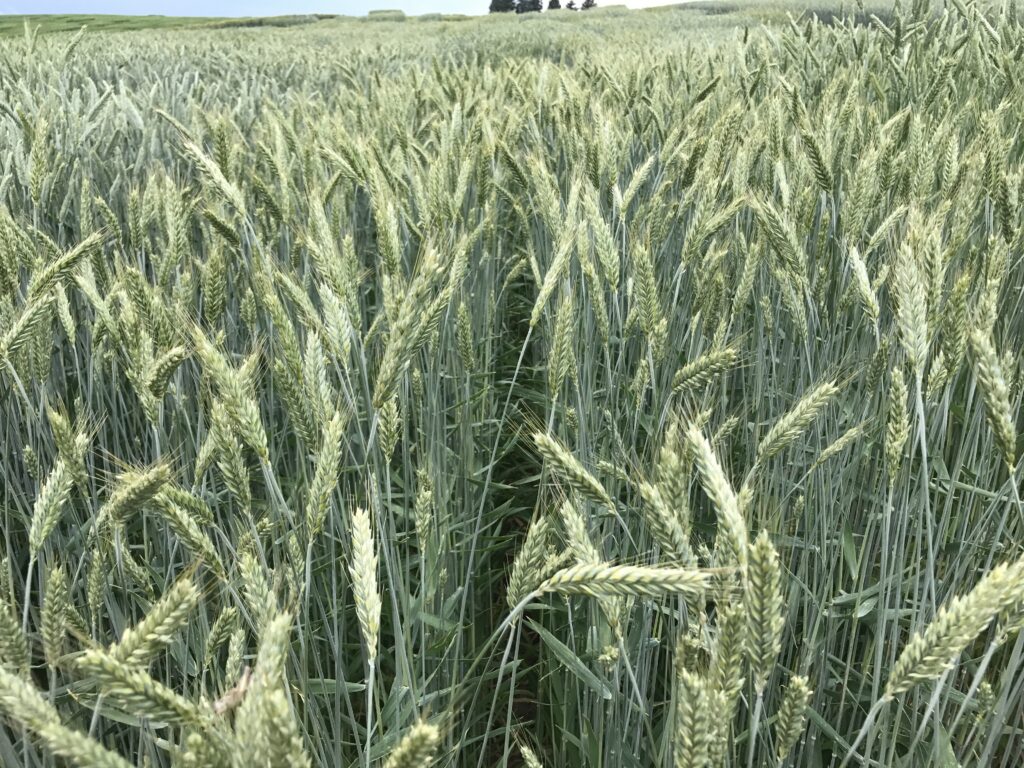
The 45Z clean fuel credit is creating a new premium market for growers who plant cover crops — and triticale may be the smartest choice in the rotation. Here’s what it means for your acres before final rules drop.
Most growers have heard of 45Z by now. But a lot of the coverage has focused on ethanol plants, fuel producers, and carbon intensity math that feels pretty far removed from the decisions you’re making in the field. Here’s the version that matters for your operation — and why triticale fits into it better than almost any other cover crop option.
What 45Z Actually Is
Section 45Z clean fuel credit of the IRS tax code — formally called the Clean Fuel Production Credit — is a federal incentive that rewards biofuel producers for making lower-carbon fuel. The credit runs through 2029, with values ranging from $0.20 to $1.00 per gallon of eligible fuel depending on how low the carbon intensity (CI) score of that fuel is. For corn ethanol, that’s significant, because roughly half of ethanol’s carbon intensity is determined by how the corn used to produce it was grown.
The credit goes to the ethanol plant, not directly to you. But here’s where it gets interesting for growers: about 60% of an ethanol plant’s CI score is tied to the CI score of the grain it buys. The lower the CI score of your corn, the more valuable your bushels are to that plant — and the more incentive they have to pay you a premium to deliver them.
Treasury proposed formal rules in February 2026, and a public comment period is underway with finalization targeted for mid-2026. The rules aren’t finished yet, but the direction is clear: growers who can document climate-smart practices will have a measurable advantage in the marketplace.
How Cover Crops Factor In
Under USDA’s interim guidelines — published in January 2025 and expected to be incorporated into final 45Z rules — a specific set of farming practices are recognized for their ability to lower a crop’s carbon intensity score. They include reduced tillage, no-till, nutrient management practices, and cover crops.
Of all the recognized practices, cover crops are confirmed as the single biggest lever for reducing CI scores. One sample calculation from Bureau County, Illinois showed that adding a cover crop alone dropped a corn farmer’s CI score from 28.42 to 19.88 — a reduction of more than 8 points. With multiple practices combined, that score dropped further to 9.56.
Why does that matter in dollars? According to analysis from agricultural consultants and ethanol industry sources, each point of CI reduction can translate to roughly $0.015 per bushel of additional value generated for the ethanol plant. If growers can lower CI scores by 18–20 points — which is achievable with cover crops plus no-till and nitrogen management — the total value pool being created at the farm level could approach $1.00 per bushel under the right contract structures. How much of that flows to the farmer will depend on individual contracting arrangements with local plants, but the pie is real and it’s growing.
45Z is essentially the federal government putting a dollar value on what good cover crop management has always done for the soil. Triticale growers have been building that carbon profile for years. Now there’s a market for it.
Where Triticale Fits
This is where TriCal’s forage system connects directly to 45Z clean fuel credit opportunity. Triticale is one of the most widely used winter cover crops in corn silage and double-crop systems across the Corn Belt and mid-Atlantic — and unlike many cover crops planted purely for agronomic benefit, triticale delivers harvestable feed value on top of the CI score improvement it provides.
For operations already running triticale behind corn silage:
- Your acres are likely already generating a lower CI score for any corn in your rotation — you just may not have documented it in a way that captures the premium yet.
- Triticale’s deep root structure and heavy biomass contribute meaningfully to the soil carbon and organic matter metrics that USDA’s carbon intensity calculator rewards.
- Adding triticale to fields that previously sat fallow over winter is one of the most straightforward paths to qualifying for a lower CI designation on your corn ground.
For operations considering adding triticale to their rotation:
- The agronomic case for triticale — erosion control, nitrogen scavenging, organic matter addition, and high-quality spring forage — now comes with a potential financial bonus from 45Z participation.
- The combination of no-till establishment and triticale cover cropping is among the most effective practice stacks for CI score reduction under current USDA guidance.
- Fields that feed into ethanol draw territory stand to benefit most directly, as premiums are expected to be structured through local plant contracts.
TriCal Tip: If you’re already planting TriCal varieties as a winter cover crop or in a double-crop system, talk to your TriCal dealer and your local grain elevator about whether your acres fall within an ethanol plant’s sourcing area. Getting your documentation in order now — tillage records, seed receipts, planting logs — positions you to participate when final rules are in place.
What You Need to Do Right Now
The rules aren’t fully finalized, but the growers who will capture 45Z premiums are the ones who are prepared when programs launch. Here’s what that preparation looks like today:
- Start documenting everything
The USDA Feedstock Carbon Intensity Calculator (FD-CIC) and any ethanol plant contracting program will require verified records of your farming practices. That means as-applied maps, seed purchase receipts, cover crop planting logs, tillage records, and field-level data. If you don’t have a system for capturing this today, build one. Third-party verification will be required, and incomplete records could result in missed payments. - Know your ethanol draw territory
45Z premiums will be structured locally, through arrangements between ethanol plants and the growers who deliver grain to them. If your corn acres are within delivery range of an ethanol plant, find out whether that plant has a low-CI sourcing program in development. Many plants are already building these programs now. The farmers who have existing relationships — and documented practices — will be first in line. - Evaluate your cover crop acres against your corn acres
Not every acre of triticale will connect to a 45Z premium — only acres where the corn that follows can be delivered into an eligible program. But if you’re running triticale in rotation with corn on ground that feeds an ethanol plant, the connection is direct. Map those fields and understand which ones sit within reach of the opportunity. - Talk to your agronomist and nutritionist together
If triticale is part of your cover crop strategy but you’re not yet capturing its feed value, now is a good time to have that conversation. Harvesting triticale as silage or haylage before it matures reduces the cover crop biomass window slightly, but the feed value it delivers can offset purchased feed costs — creating a second source of ROI on top of any future 45Z participation.
The Bigger Picture
45Z is still evolving. Final regulations are expected in mid-2026, and the details around how premiums flow from ethanol plants to growers are still being worked out. What’s not in question is the direction: federal policy is building a market that rewards growers for the conservation practices that reduce the carbon intensity of their crops, and cover crops sit at the top of that list.
Triticale growers are already doing the thing that 45Z is trying to incentivize. The work now is making sure that work gets documented, connected to the right market relationships, and compensated accordingly.
This is a developing story — Ground Level will continue to track it as final rules take shape and premiums begin to move through the market. In the meantime, the best thing you can do is get your fields, your records, and your relationships in order.
TriCal Tip: Questions about how your triticale acres might connect to 45Z opportunity? Start with your TriCal dealer and your local elevator. The conversation is worth having now — before the programs are finalized and the early movers have already locked in their contracts.
Don’t wait for final rules to get your rotation ready. Talk to your nearest TriCal dealer today — they can help you match the right product to your fields and get your acres positioned for what’s coming.