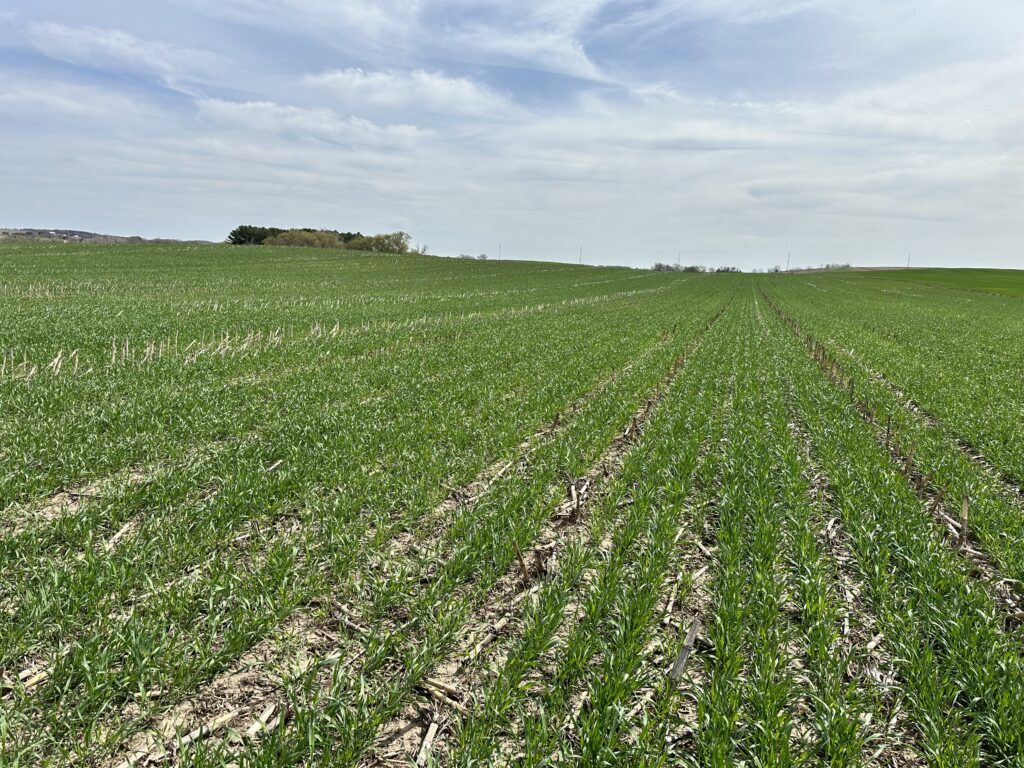
Early-Season Triticale Health
You’ve put the seed in the ground. Now comes the moment of truth—and knowing what you’re looking at makes all the difference. Spring green-up is one of the most satisfying moments in any forage operation, and with triticale it comes early. What you see this spring tells you a lot about what you’ll be harvesting in early summer—if you know what to look for.
What Healthy Emergence and Tillering Look Like
A healthy fall-planted triticale stand coming out of dormancy should show vigorous, uniform green-up across the field. Well-established stands typically show three to five tillers per plant. Leaves should be upright and uniform in color—a consistent medium to dark green.
- Uneven green-up that suggests winterkill pockets
- Yellowing that indicates nutrient deficiency or disease pressure
- Thin stands caused by poor germination or seeding rate issues
Plant Population and Stand Adequacy
A quick stand count helps determine whether the field is on track. Mark off a one-square-foot area in several spots across the field, count the number of live plants, and average the counts.
Target: 20–25 plants per square foot for a full-yield stand. If counts fall below 10 plants per square foot, yield potential is significantly reduced.
Common Early-Season Issues
- Winterkill: Dead or bleached areas that fail to green up.
- Crown rust and leaf diseases: Orange pustules or brown lesions on leaves.
- Nitrogen deficiency: Yellowing that starts on older leaves and moves upward.
TriCal varieties are selected for uniform spring green-up and aggressive tillering. If stands show inconsistent emergence or weak tillering, it may indicate a field-specific issue worth diagnosing early.
The Spring Green-Up Advantage
Early scouting provides valuable insight into stand health and yield potential. When you understand what your stand is telling you now, you can make better management decisions for the rest of the season.