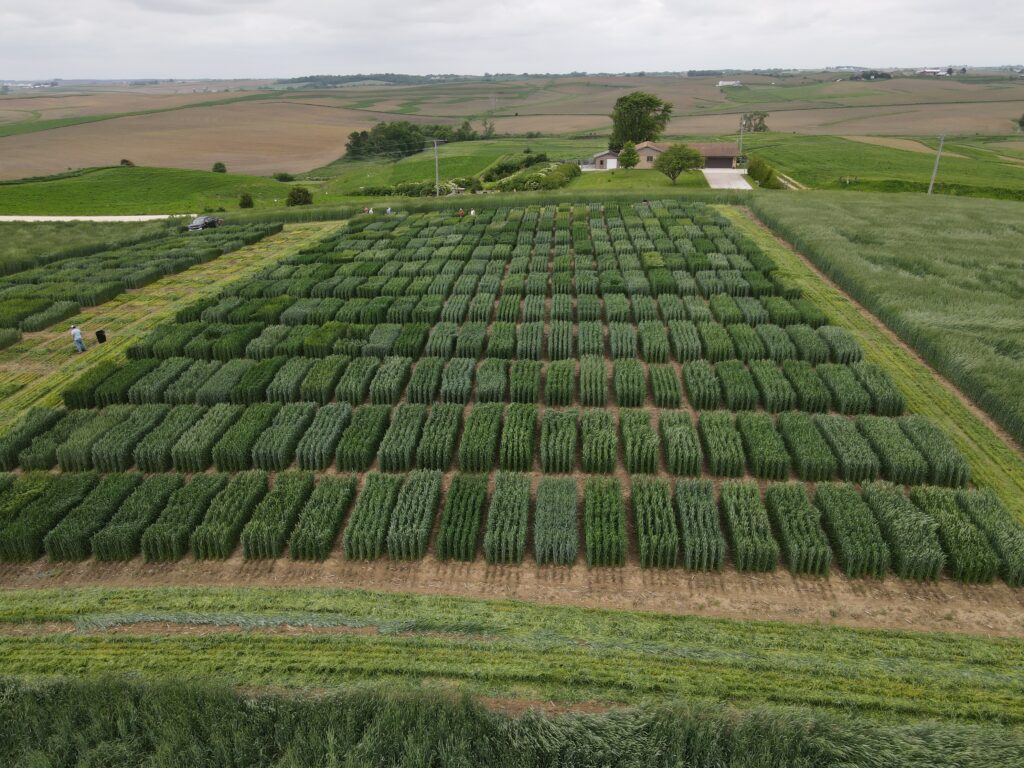
Most growers spend a lot of time thinking about nitrogen on their triticale acres. Far fewer think about sulfur. In a year where every ton of forage matters, that’s the gap worth closing — because sulfur is the nutrient that quietly determines whether your nitrogen program actually pays out the way it should.
If you’ve been growing triticale for a few years, you’ve probably already settled into a nitrogen program that works reasonably well for your soils and your yield goals. That’s a good starting point. But there’s a fertility question most growers haven’t worked through with the same rigor, and it’s increasingly the limiting factor on triticale yield and forage quality: sulfur.
This post walks through why sulfur matters more than it used to, what deficiency actually costs you, and how to build a practical sulfur program that gets your nitrogen dollar working harder.
Why Sulfur Matters More Than It Used To
Sulfur and nitrogen are linked nutrients. Sulfur is a building block of the amino acids and proteins that nitrogen ultimately produces in the plant. When sulfur is deficient, the plant can’t convert nitrogen into protein efficiently. You end up with two related problems: lower crude protein in the forage, and nitrogen that gets used less efficiently — meaning some of what you applied is essentially wasted.
The ratio matters. Most small grains forages respond best when nitrogen and sulfur are kept in roughly a 10:1 to 15:1 ratio (N:S). At higher ratios — meaning too much N relative to S — you start seeing diminishing protein returns and reduced nitrogen use efficiency.
What’s changed
Two things have shifted over the last couple of decades. First, atmospheric sulfur deposition has dropped significantly as Clean Air Act regulations reduced industrial sulfur emissions — the free sulfur many fields used to get from the sky simply isn’t there anymore. Second, higher-yielding modern forage systems are pulling more sulfur out of the soil than they used to. The combination has turned sulfur from a nutrient growers rarely thought about into one that often shows up as a limiting factor.
If your fertility program hasn’t changed much in the last 10 to 15 years, there’s a good chance your sulfur strategy is now under-spec’d for the way you actually farm today.
What Deficiency Looks Like — and What It Costs
Sulfur deficiency in triticale typically shows up as pale, yellow-green growth on the newer (upper) leaves. That’s the opposite of nitrogen deficiency, which starts on older lower leaves and moves up. The visual cue matters because the two can be confused, and the response is different.
Even when deficiency isn’t visible, sub-optimal sulfur often shows up in lab reports as lower crude protein than expected for your nitrogen rate. If you’ve been applying 100+ pounds of spring N and your forage is testing at the low end of the protein range, sulfur is one of the first things worth checking.
The economic cost
The real cost of sulfur deficiency isn’t usually visible damage — it’s invisible underperformance. A few examples of what that looks like in dollar terms:
- Crude protein 1 to 2 percentage points lower than it could be — which translates directly to higher purchased protein costs in your livestock ration
- Nitrogen use efficiency dropping by 10% to 20%, meaning a portion of your N application is essentially unrecoverable
- Yield response to higher N rates flattening out earlier than it should, capping your top end on dry matter per acre
None of these losses show up as a single, obvious problem you can point at. They show up as a forage system that just doesn’t quite hit the numbers you’d expect from your inputs. That’s what makes sulfur deficiency easy to miss — and expensive when it goes unaddressed.
Building a Sulfur Program for Triticale
A practical sulfur program doesn’t have to be complicated. A few principles will get most operations most of the way there:
Target rate
- Aim for 15 to 25 pounds of actual sulfur per acre on forage triticale acres. This is a starting range — adjust based on soil test, historical response, and yield goal.
Source
- Use a sulfate-form source where possible. Ammonium sulfate, calcium sulfate (gypsum), or potassium sulfate provide immediately plant-available sulfur.
- Elemental sulfur takes time to convert and is better suited as a longer-term soil amendment than as in-season nutrition.
Timing
- Apply sulfur with or shortly before your spring nitrogen top-dress. This gives the plant both nutrients during the critical rapid-growth window.
- Late-applied sulfur has less effect on protein content — the protein-building work is largely done by the time stem elongation is well underway.
Verification
- Tissue test if you’re unsure. A mid-season tissue test that includes both N and S — and reports the N:S ratio — tells you whether your program is balanced or whether you’re leaving protein on the table.
- Track sulfur applications and resulting forage quality data year over year. Two to three seasons of data tells you what your sweet spot is.
Where to be extra attentive
- Sandy soils leach sulfur quickly and almost always benefit from in-season sulfate-form applications.
- High-organic-matter fields can tie up sulfur in organic forms that aren’t immediately available, particularly early in the spring when soil temperatures are still cool.
- Fields with a long history of high-N fertility programs but no sulfur additions are often the highest-response fields when sulfur is finally added.
TriCal Tip: Sulfur is one of the highest-ROI fertility inputs in modern small grains forage systems — and one of the most overlooked. Pair a TriCal product with a balanced N and S program, and you’ll see the difference in yield, protein, and how far your nitrogen dollar actually goes.
The Bottom Line
Nitrogen gets most of the attention in triticale fertility conversations, and for good reason — it’s the biggest single driver of yield and quality. But nitrogen doesn’t work alone. Sulfur is what lets nitrogen do its job. Without it, you’re paying for fertility you’re not actually capturing.
In a year where every ton of high-quality forage matters more than usual, the operations that get the N:S balance right will see it show up in yield, in protein content, and in how far their fertility budget actually stretches. That’s the case for putting sulfur on your short list of fertility decisions this year — not next.